




Access to required goods can be a major challenge, especially in economically disadvantaged regions, and is often linked to dependence on imports. Tando was born out of an exchange with a Tanzanian medical student who emphasised the need for affordable and locally producible solutions. Originally focussed on specific problems in Tanzania, Tando has developed into a globally scalable concept.
The concept has won the Next Gen Design Competition and will be exhibited in the travelling exhibition in the Design Festivals in Belgrade, Vienna, Amsterdam, Barcelona and Skopje. It has also won the iF Design Student Award 2025 as Best of the Year. The project will be awarded in the Guggenheim Museum in Bilbao and exhibited in Taipei.
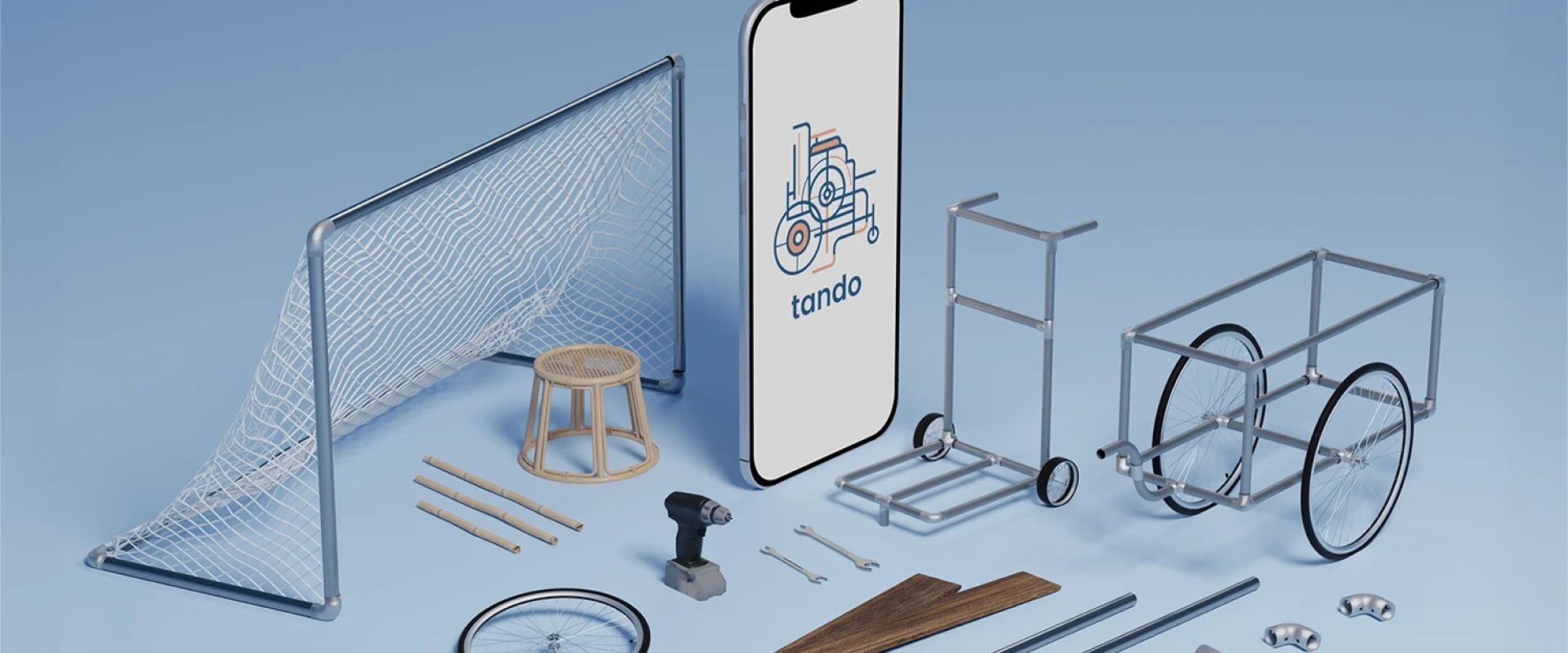
Tando is an open source platform that enables communities to provide themselves with needed goods. By using locally available tools and materials such as wood or bamboo, textiles, metal pipes or bicycle parts, Tando empowers communities to produce the goods they need themselves and pass on handicraft techniques. This promotes independence, co-operation and sustainable local economic growth. This enables the creation of a wide variety of items, from hospital equipment, furniture, means of transport such as wheelbarrows or trailers to sports and leisure equipment.
Through crowdfunding, community projects such as the construction of public sports facilities or playgrounds can be realised by and for the communities. In addition, goods such as wheelchairs or crutches can be donated to people who cannot afford them despite the low cost.
In contrast to ‘development aid’, which often tries to implement a ‘one fits all’ solution for everyone from outside, Tando focuses on customised solutions, that the communities themselves develop for themselves and their needs. Instead of expensive imports, Tando offers cost-effective, repairable products with modular components and readily available spare parts. In this way, Tando promotes a circular economy, resource conservation and cost efficiency through the reuse of materials, modularity and reparability.
The open-source approach makes the app inclusive and customisable, as users can adapt the functions and design to their needs. Visual instructions in the form of drawings or videos make manufacturing practical and accessible and open up a new field of work possibilities, even for illiterate users.
Users are not only encouraged to consume, but also to create. The app supports creativity by giving also young people the opportunity to contribute ideas, refine designs and collaborate on community projects. The process allows users to preserve traditional knowledge while contributing new innovations, making the system adaptable and sustainable for different regions, contexts and needs. Tando also supports young entrepreneurs by providing them with a platform where they can showcase their services, sell products, accept enquiries and connect with other stakeholders to start their own business. The commitment to technology and software development helps to bridge the digital divide.
Users can act as developers to refine software, improve instructions and create new designs. The platform encourages collaboration through community group chats to share topics and support each other. Therefore, Tando enables continuous improvement and innovation. This approach creates a self-sustaining ecosystem where communities are empowered to drive their own economic growth and development.
To provide you with the best possible experience, we use technologies such as cookies to store and/or access device information. If you consent to these technologies, we may process data such as browsing behaviour or unique identifiers on this website. If you do not give your consent or withdraw it, certain features and functions may be affected.